Rank: Newbie
Groups: Registered
Joined: 3/20/2026(UTC) Posts: 3  Location: Wilmington Thanks: 1 times
|
VRC (Video Recording Control)VRC is a centralized Windows application designed to remotely MONITOR and CONTROL multiple vMix instances from a single dashboard. Stop jumping between different computers to manage your broadcast. With VRC, you have full remote command over your vMix nodes:
- π΄ Full Remote Control: Start, stop, and manage Recording, Streaming, External outputs, and Multicorder with a single click or via custom keyboard shortcuts (perfect for Elgato Stream Deck).
- π Deep Monitoring: Track CPU/GPU usage and audio levels in real-time via WMI and API.
- β° Smart Automation: Built-in Task Scheduler to automate your vMix commands based on precise timing.
(Note: While the architecture is designed as a "Hub", the current release is heavily optimized for deep and stable integration exclusively with vMix).Why VRC? (The Problem It Solves)In professional live production, you rarely rely on a single machine. You might have one vMix PC for the main mix, another for instant replays, and a third for graphics or encoding. Monitoring and controlling all of them simultaneously usually requires a large crew or constantly switching between KVMs, which leads to missed cues, high stress, and potential on-air failures. VRC was built to solve this exact problem. It turns any Windows tablet or laptop on your network into a Master Control Room. Who is this for?
- Solo Operators & Small Crews: Manage recording, streaming, and switching across multiple PCs without needing extra hands. Ideal for local sports, corporate events, and live gigs.
- Esports Productions: Control complex multi-node setups (player POVs, caster desks, main feed) from one central hub with precision timing.
- Broadcast Engineers & Technical Directors: Monitor CPU and GPU loads, audio levels, and crucially, track remaining free disk space across all nodes in real-time. Prevent stream crashes and ruined recordings before they happen.
Download & RepositoryYou can download the latest release and find the full documentation here: https://github.com/Kotin-ak/VRC-Releases/releasesπ Installation (Important!)IMPORTANT: Because VRC is a locally signed .msix package, you MUST install the security certificate first, otherwise Windows will block the installation.
- Download the .zip archive from the Releases page and extract it.
- Install the security certificate: Right-click the certificate file, select Install, and place it in "Local Machine" -> "Trusted People".
- Install Dependencies: The extracted folder contains a Dependencies directory with additional required resources. Since this is a 64-bit Windows package, navigate to Dependencies\x64 and install the Windows App Runtime by double-clicking: Microsoft.WindowsAppRuntime.2.0-preview1.msix
- Install VRC: Finally, double-click the main VRC .msix file to install the app.
(A detailed step-by-step image guide is included in the zip).[hr] VRC β Feature ReferenceQuote:User guide for VRC (Video Recording Control Hub) application features. [hr] 1. DashboardThe main screen of the application β a grid of connected device cards with real-time monitoring. Command Bar
- Add vMix (Ctrl+N): Opens the dialog to add a new vMix device
- Last Session: Load the last saved session
- Save Preset (Ctrl+S): Save current device configuration to the selected preset
- Card Size: Cycle through device card sizes
The status bar displays the current preset name and the number of connected devices. Additional Commands (overflow menu "β―")
- Save As⦠(Ctrl+Shift+S): Save configuration under a new name
- Delete Preset: Delete the selected preset
- Export Preset: Export preset to a file for transfer or backup
- Import Preset: Import preset from a file
- Export Configuration: Export full application configuration
- Import Configuration: Import full application configuration
Card Display
- Device cards are arranged in an adaptive grid that automatically adjusts to the window size.
- Pagination β when there are many devices, cards are split across pages with a dot indicator for navigation. Mouse wheel scrolling is supported.
[hr] 2. vMix Device ManagementAdding a Device When adding a new vMix device, the following fields are specified:
- Name β custom name (up to 20 characters).
- IP Address β address of the machine running vMix.
- HTTP Port β vMix Web API port.
- TCP Port β TCP API port (configured automatically).
- Polling Interval β data refresh rate (250β5000 ms).
- Login and Password β credentials for authorization (if required).
- Transport Mode β communication method with vMix (HTTP, TCP, etc.). A warning about limitations is displayed when HTTP is selected.
- Time Zone β time zone assignment for the device to ensure correct time display during remote operation.
Connectivity Check (Probe)Before saving, you can test the connection to the device. The result and details are displayed directly in the dialog. Connection Options
- Auto-Connect β automatically connect to the device on application startup.
- Auto-Reconnect β automatically restore the connection when it is lost.
Device Actions (Card context menu)
- Streaming Settings β open the streaming channel management dialog.
- Edit β modify connection parameters.
- WMI Settings β configure remote PC monitoring.
- Logs β view the device event log.
- Delete β remove the device from the configuration.
- Move toβ¦ β move the device between groups.
[hr] 3. Device CardEach connected vMix device is displayed as a card with full real-time information. Below is a detailed description of all vMix control features available directly from the card. 3.1. Header
- Device name, IP address, transport mode.
- vMix version and edition, preset name.
- Device time zone.
- Color-coded connection status indicator.
- Context menu (β―) β streaming settings, edit, WMI, logs, delete, move between groups.
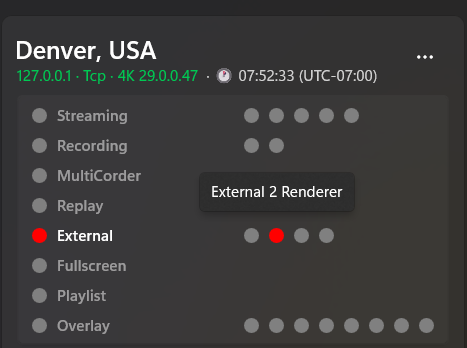
3.2. Status Indicators Interactive indicators β clicking toggles the corresponding vMix function:
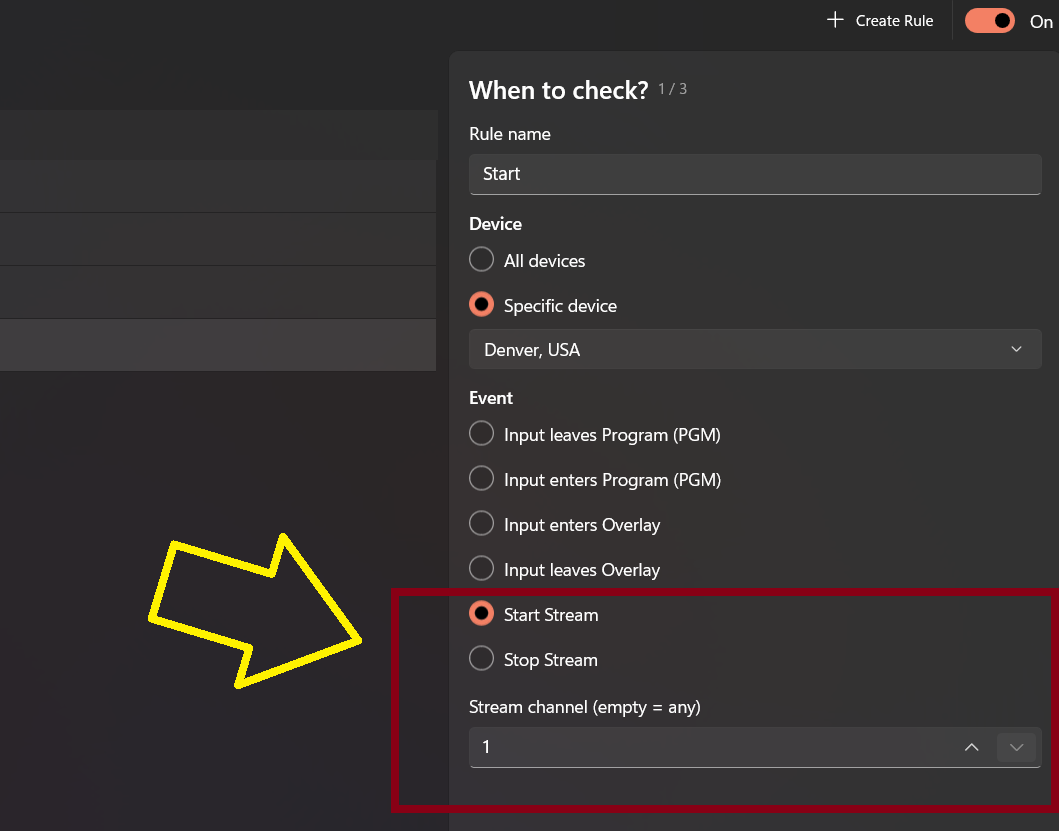
- Streaming: Start/stop all channels (Individual indicators 1β5 are clickable).
- Recording: Start/stop recording (Primary/secondary indicators, duration timer).
- Multicorder: Start/stop multi-recording (if supported by edition).
- Replay: Start/stop Instant Replay recording (if supported by edition).
- External: Toggle external output on/off.
- Fullscreen: Toggle fullscreen mode on/off.
- Playlist: Start/stop playlist.
- Overlay: Disable all overlays (Individual indicators 1-8 are clickable).
3.3. Program Monitor Section displaying the current source in Program/Preview with audio levels. Monitor Source Selection:
- Program / Preview: Main or Preview output.
- PRV | PGM: Automatic β displays the active source.
- Output 1β4: External outputs.
- Overlay 1β8: Overlay layers.
Information Panel:
- Current input name β name and label of the playing source.
- Progress bar β for playable sources (video), showing remaining time.
- Playback status β Play / Pause / Stop icons.
- Loop β loop indicator.
- List position β element index display for video lists.
- Title text β current text for title inputs.
Master Audio Meter:
- Dual-channel (L/R) vertical Master bus level indicator.
- Gradient: green (normal) -> yellow (headroom) -> red (clipping). Tooltip with peak values (dBFS).
3.4. Inputs Tab β Input Control List of all vMix inputs with pagination. Primary actions (buttons):
- GO / QuickPlay: Transition to input.
- Cut: Instant switch to input.
- Play / Pause: For video inputs.
- Loop: Toggle playback looping.
- Mute: Mute / unmute input audio.
Input context menu (right-click):
- Active / Preview: Send input to Program or Preview.
- Restart: Restart playback (for video).
- AutoPause / AutoPlay / AutoRestart: Toggle automation features.
- Video Source (1β4) / Audio Source: Routing for Video Call inputs.
3.5. Audio Tab β Audio MixerFull-featured audio mixer with separate control of the master bus, buses, and inputs. Master Bus & Audio Buses (Bus AβG)
- Mute: Mute / unmute bus.
- Send to Master (M): Route bus to master.
- Volume slider: Bus level adjustment (0β100%).
- Solo (S): Solo-listen the bus.
Per-Input Audio
- Mute / Solo (S): Toggle states.
- AFV: Audio Follow Video toggle.
- Routing (M, AβG): Assign input to buses.
- Volume slider: Input level adjustment via popup fader.
3.6. List Tab β Video List Management
- Item List: Display of files with duration and color highlight for the playing item.
- Playback Controls: Previous, Play/Pause, Next, Shuffle, Loop.
- Additional Commands: Play Out, Auto Next, Auto First.
3.7. Outputs Tab β Output Control
- Fullscreen 1 & 2: Source selection via SplitButton.
- External Outputs (1β4): Source assignment, NDI (On/Off), OMT (On/Off), SRT streaming status toggle.
3.9. Scheduler Tab β Device Schedule Compact list of scheduled tasks with time-until-next-task indicator. 3.10. Card Footer
- Lock: Protection against accidental actions.
- Collapse Audio: Show/hide the audio section.
- Notifications: Enable/disable notifications per device.
- Connection Toggle: Enable/disable connection.
[hr] 4. PC Health Monitoring Remote collection of workstation metrics via WMI:
- CPU β processor load.
- GPU 3D & GPU Encode β graphics card and hardware encoder load.
When remote monitoring is unavailable, WMI/RPC error information is displayed.  [hr] 5. Streaming Settings Dialog for managing streaming channels (Individual toggles 1-3), connection status, and IP info. [hr] 6. Task SchedulerCentralized management of deferred and recurring commands.
- Task Creation: Target device, Category, Function, Parameters, Schedule (one-time/daily/weekly), Retries.
- Bulk Actions: Hold, Run Now, Postpone (+5 / +10 / +15 min), Cancel, Restore.
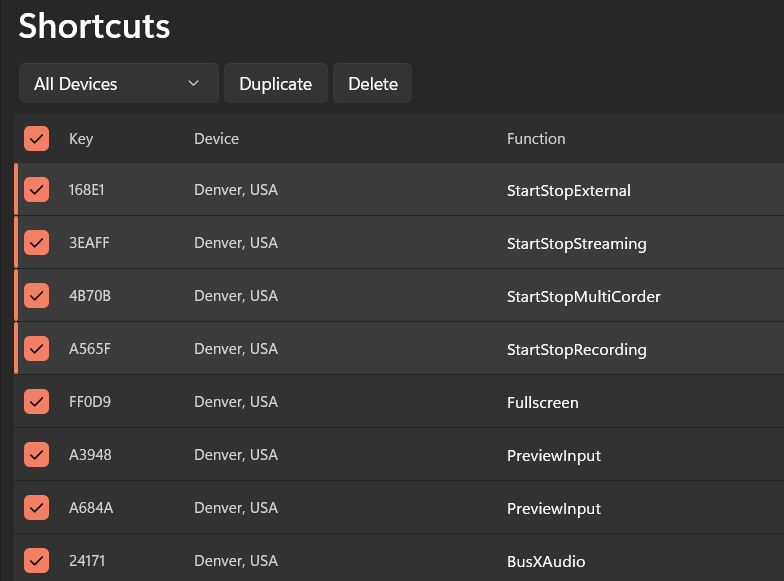
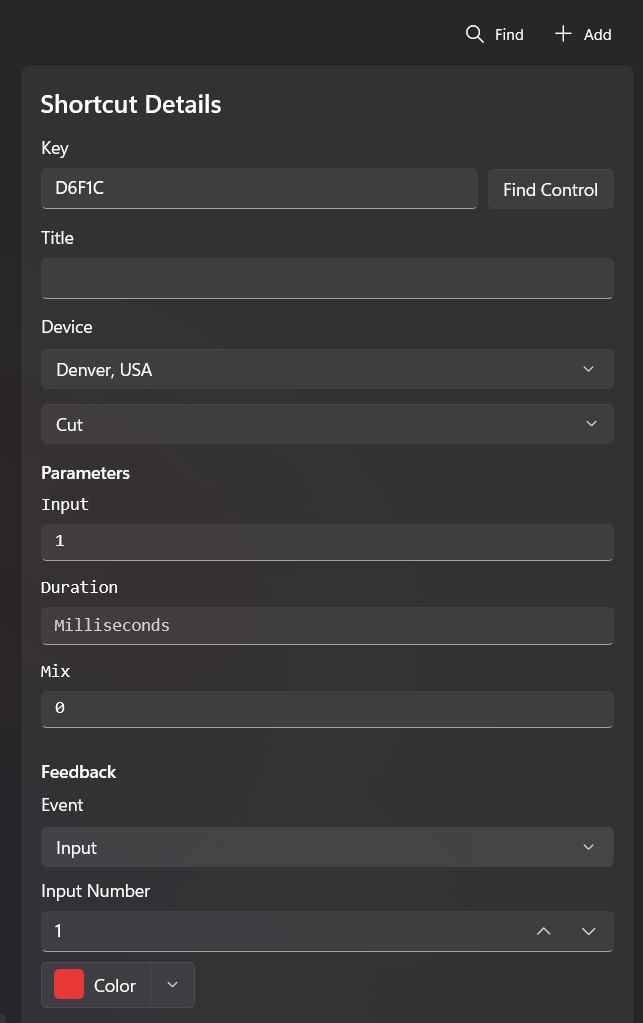
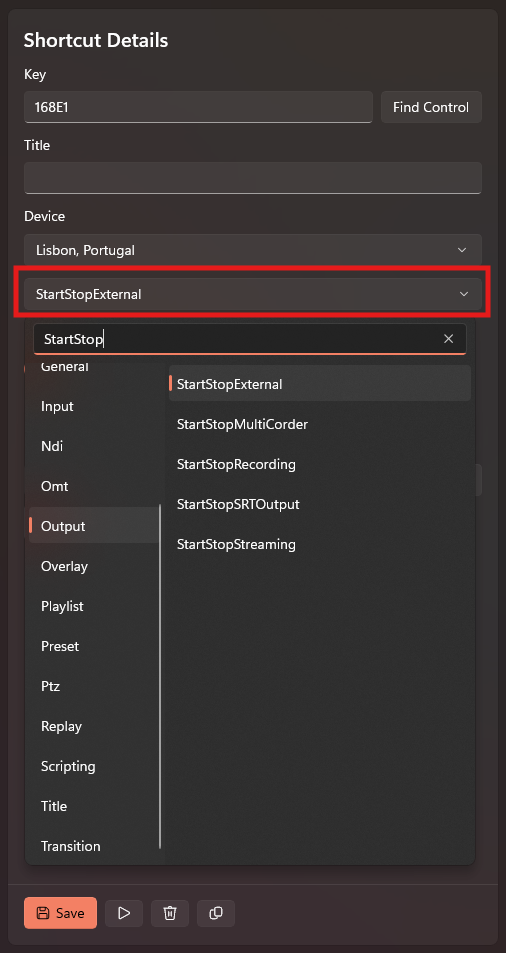
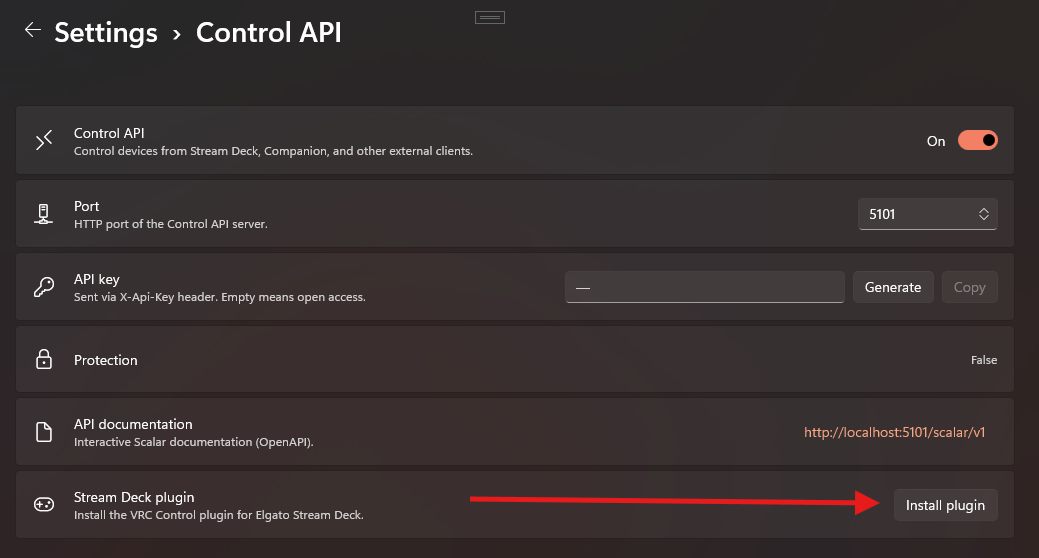
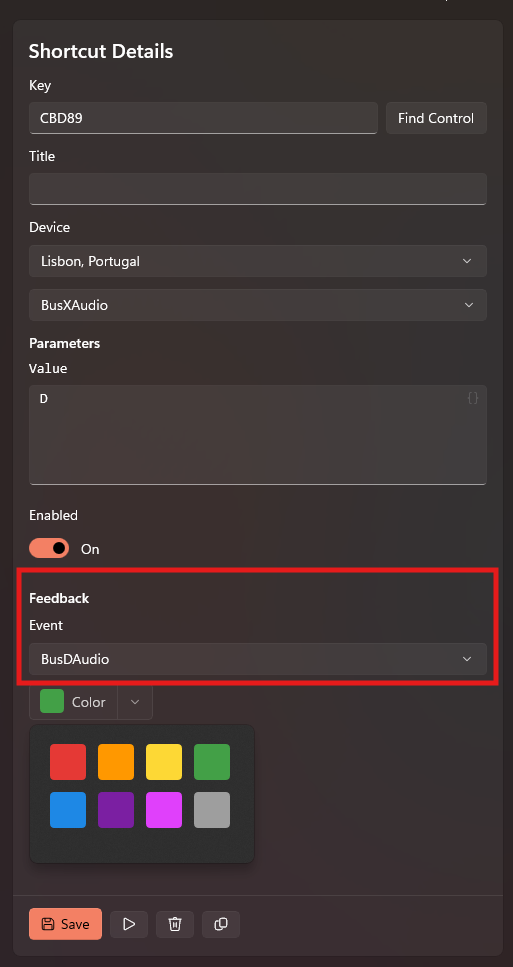
 [hr] 7. Shortcuts (External Controller Integration) Binding external controller buttons (Stream Deck, Companion, Touch Portal, etc.) to VRC commands. All configuration is done entirely within VRC β the external device acts as a "thin client". How It Works 1. Drag "VRC Control" onto a Stream Deck button. 2. In VRC, open Shortcuts and click Add. 3. The Find Control dialog opens β press a physical button on the controller. 4. VRC captures the ID. Configure the command (Device -> Category -> Function -> Parameters). Feedback SettingsConfigures visual feedback (Smart Tally) sent back to the controller with zero delay.
- Event: ACTS event type (Recording, Streaming, InputAudio, Overlays, etc.)
- Color: Feedback color for the button when the event is active.
[hr] 8. Application Settings
- General: Language, Minimize to Tray, Auto-Start.
- Notifications: Toast notifications mode, Connection alerts.
- Web Dashboard: Activate built-in web server, Port config.
- Logs and Diagnostics: Device logs folder, GC Monitor.
 [hr] 9. Web Dashboard Built-in read-only dashboard accessible from any browser on the local network. Features Real-time updates via SignalR, displaying tally states (REC, STREAM, EXT, MCR, FS, FTB) and audio meters. [hr] Download and more details: https://github.com/Kotin-ak/VRC-Releases
|